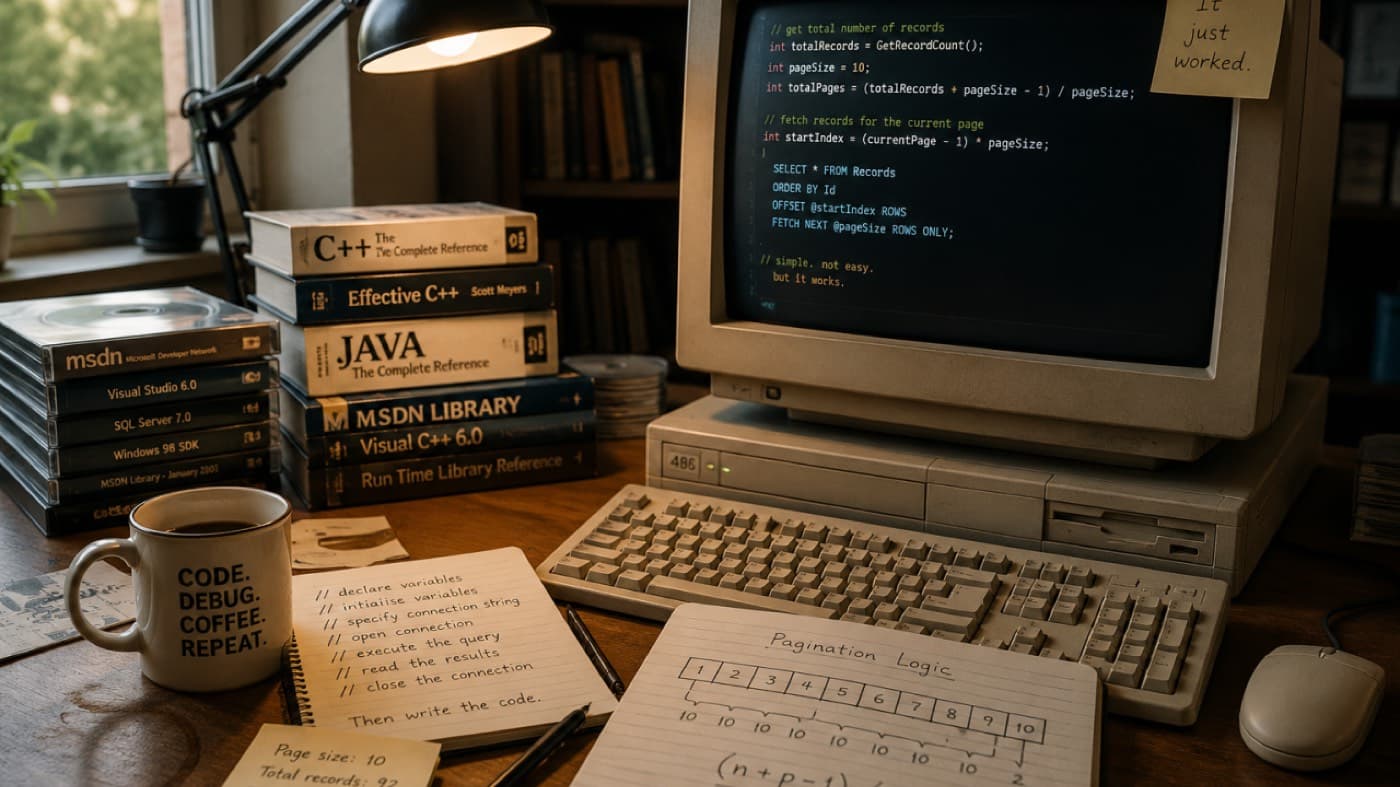
I spent an entire day, as a fresher, figuring out how to paginate a list.
Page size of 10. Ninety-two records. I wanted ten pages nine full ones, and a tenth holding the last two. Simple to say. Maddening to get right. I kept landing on nine pages, or a phantom eleventh, or a tenth page that crashed on the records that weren't there.
Then, late in the day, it clicked: (number of records + page size − 1) / page size.
I ran it. Ten pages. The last one held two records. It just... worked.
I remember leaning back in the chair feeling like I'd discovered fire. (There were probably ten cleaner ways to do it a ceiling function, modulo arithmetic, who knows. I didn't care. I'd found mine.)
That feeling has a name. It's the joy of creation. And lately 26 years into this career I've been quietly missing it.
The friction was the feature
Let me take you back to how we actually worked.
There was no IntelliSense whispering the available methods the moment you typed a dot after an object. You knew the object, or you didn't ship. The dot was not a menu it was a test of whether you'd done your reading.
A single mistyped variable in JavaScript could swallow an entire afternoon. No red squiggle, no linter shouting at you. Your only torch in that dark room was console.log or, going further back, a humble printf — dropped line by line until the bug finally confessed where it lived.
Documentation didn't live in a browser tab. The company had an MSDN subscription that arrived as a stack of CDs. When you were stuck, you got up, walked to the shelf in the library, found the right disc, loaded it, and read. Slowly. Properly. You came back to your desk not with a copy-pasted snippet but with understanding.
And before we wrote a single line of logic, many of us wrote the comments first:
Then and only then did we fill in the actual code beneath each line. We designed in plain English before we wrote a word of syntax. The structure existed in our heads before it existed in the editor.
And the best days? The best days were when you wrote an entire method in a single sitting, ran it, and it worked exactly as intended first time, as-is. No corrections. You wouldn't shout about it. You'd just sit there for a second, quietly proud, and maybe tell the person at the next desk.
All of this was friction. Slow, frustrating, expensive friction. And here is the uncomfortable truth I've been sitting with for months:
The friction was the feature. The struggle is what made the arrival worth feeling.
Helicopters and mountains
I think coding today is like the difference between climbing a mountain and being flown to the summit in a helicopter.
The helicopter delivers you to the very same view faster, safer, no blisters, no thin-air panic, no wrong turns. By every measurable outcome, it wins. The photo from the top is identical.
But nobody who took the helicopter ever stood at that summit and wept. The view at the top only means something to the legs that earned it. The struggle on the way up is not a tax on the achievement it is the achievement. The summit is just where you happen to be standing when it lands on you.
AI is our helicopter. And I want to be very clear: it is an extraordinary one. I use it every single day. I've written before about modernising legacy code with it, about whether GenAI can build production-ready systems and my honest answer remains yes, and. It removes precisely the friction we used to curse: the missing method, the typo hunt, the long walk to the documentation shelf. The pagination formula that once cost me a full day now arrives in a single second with three alternatives, edge cases handled, and a tidy explanation of why it works.
That is real progress. I would not send a single young engineer back to the CDs.
But I would be lying if I told you nothing was lost.
What we owe the next generation
Here is what actually keeps me up at night.
My pagination day was not wasted time. It was training. The struggle wired something permanent into me patience, the instinct to break a big problem into smaller ones, the muscle to sit inside confusion without panicking and quitting. I came out the other side a slightly better engineer than I went in. And every fresher of my generation who fought their own version of that bug emerged a little more capable for it.
So I worry about a simple thing. If the helicopter is always idling on the pad, when does the next generation ever build the legs?
This matters more in our context than most. India sends lakhs of young engineers into this industry every year, and the entry-level rungs of the ladder are exactly the ones AI is sanding down first. If a fresher never struggles, never debugs blind, never reasons a problem to the ground unaided what exactly are they senior in, ten years from now?
I don't think the answer is nostalgia. We are not going back, and we shouldn't. The answer is intention. A few things I'm trying to hold onto, and to pass on:
Struggle on purpose, sometimes. Attempt the problem yourself first — then open the AI. Not for the output. For the muscle. The model can wait five minutes.
Keep "comments first" alive. Think in plain language before you generate anything. The model is a faster typist than you. It is not a replacement for your thinking — and the day you outsource the thinking is the day you stop being the engineer in the room.
Earn at least one summit the hard way. Every engineer deserves to feel one stubborn bug surrender to them, once, completely unaided. That single memory becomes the standard they hold everything else to.
Because here's the part I keep coming back to. The joy of creation never actually left us. It only moved.
It moved from will this method even run to did I ask the right question, frame the right problem, and judge the answer well. The craft shifted from typing to thinking from writing the code to owning the outcome. The dot after the object used to test your memory. Now the work tests your judgement. That is a harder, higher skill, not a lesser one.
The helicopter is here to stay, and I'm grateful for it.
But every now and then for the muscle, for the memory, for the quiet pride at the next desk climb.
Comment if this makes you nostalgic :)
First published on LinkedIn.