The Indian IT services industry is quietly undergoing one of the biggest shifts in its history. With AI and automation maturing at an exponential pace, we are approaching a tipping point—one where the traditional headcount-driven model of IT services is being fundamentally challenged.
Over the last few years, we’ve seen a marked decline in the hiring of entry-level programmers, delayed onboarding cycles, and a reduced intake of freshers by major players like TCS, Infosys, and Wipro. And while this trend has often been attributed to cyclical slowdowns, the underlying cause is structural: AI is beginning to replace routine tech jobs.
📉 Three-Year Hiring Trend for Entry-Level Programmers (2022–2024)
2022–23: Entry-level hiring slowed significantly post-COVID hiring sprees.
2023–24: Reports indicated that over 10,000 freshers had their offers delayed or revoked.
2024–25: Fresh hiring picked up slightly, but far below pre-pandemic levels, with increased expectations of domain or AI skills.
A World Economic Forum report predicts that 23% of jobs globally will be disrupted by AI and automation by 2027. In India—where the services sector dominates employment—the impact will be even sharper.
⚠️ Why This Matters: The Indian IT Model is Being Disrupted
For decades, India’s IT services sector thrived on scale. Large teams of developers, testers, and support engineers powered global enterprise IT at competitive costs. But today:
AI is automating much of the work that freshers used to do: code generation, bug fixing, test case creation, and even customer support.
Mid-level managers who lack hands-on expertise are being replaced by AI-driven dashboards and project trackers.
Sales and presales roles without tech/product context are being outperformed by AI-generated proposals and tools like ChatGPT.
🔍 Who’s Most at Risk?
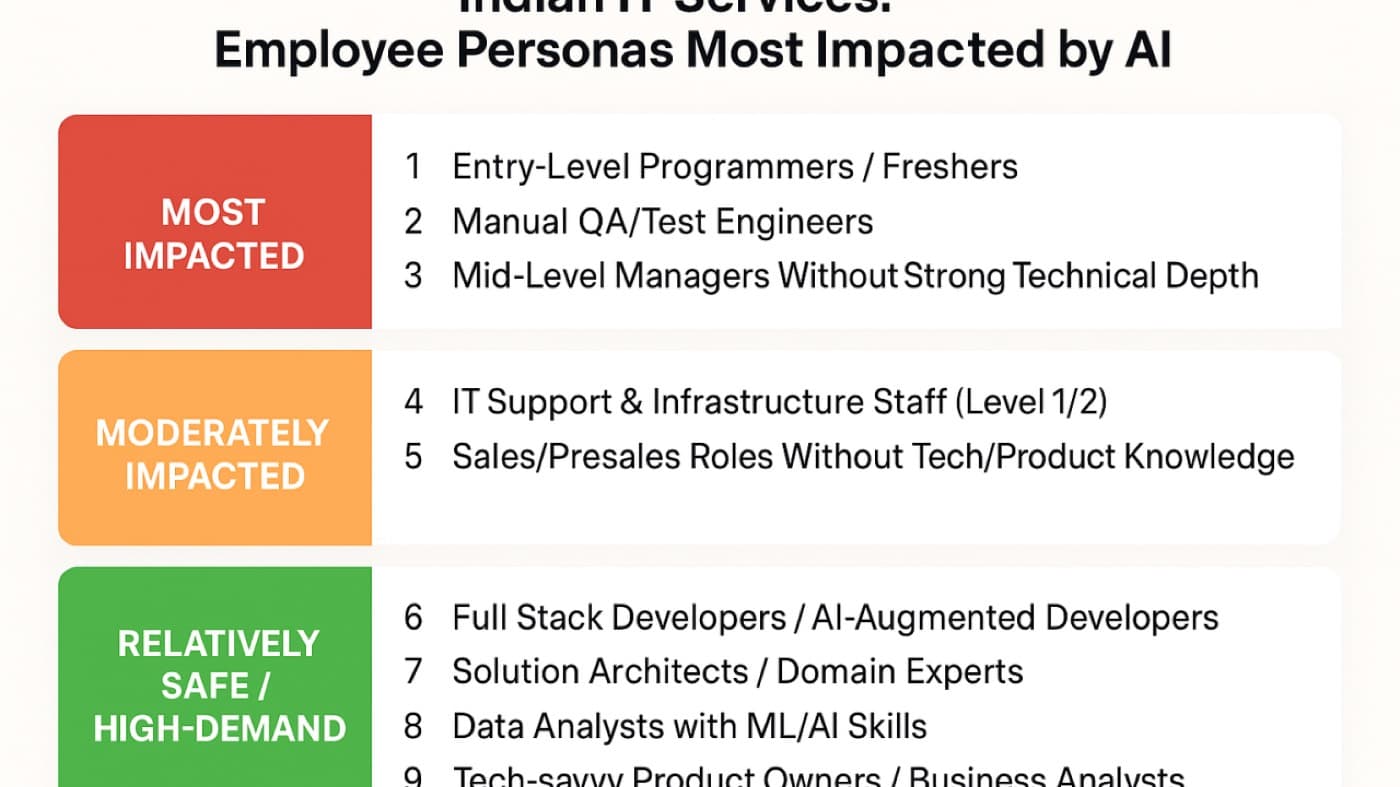
Here’s a snapshot of the personas most impacted by the AI wave in the Indian IT ecosystem:
🔴 Most Impacted
Entry-Level Programmers / Freshers
Manual QA/Test Engineers
Mid-Level Managers Without Technical Depth
🟠 Moderately Impacted
IT Support Staff (Level 1/2)
Sales/Presales Without Tech Context
🟢 Relatively Safe / In-Demand
AI-Augmented Full Stack Developers
Solution Architects / Domain Experts
Data Analysts with ML Skills
Tech-Savvy Product Owners / BAs
🔄 Will New Roles Compensate the Loss?
Yes—and no.
While new-age roles like prompt engineers, AI ethicists, and automation consultants are emerging, they require deeper expertise, broader context, and are fewer in number. A single AI-savvy developer may do the work of five freshers.
This means that while productivity and revenue per employee may go up, overall employment numbers may go down unless we reskill at scale.
✅ What IT Companies & Professionals Must Do Now
For IT Companies:
Shift from headcount billing to value/outcome-based models
Invest heavily in reskilling and upskilling programs
Promote AI augmentation instead of fearing AI displacement
Automate internally—not just for clients
For Professionals:
Learn to leverage AI tools in your day-to-day workflows
Focus on problem-solving, product thinking, and cross-domain skills
Shift from “just coding” to understanding system design and impact
Stay curious, adaptable, and keep building
🔚 Final Thought
AI isn’t the enemy—it’s an amplifier. But it will amplify only those who learn, adapt, and evolve.
The Indian IT sector has always been resilient and resourceful. With the right leadership and a future-ready mindset, we can transition from a service engine to a global innovation hub.
Let’s lead that change—before we’re forced to.
💬 What’s your take?
Are you already seeing changes in your role or team due to AI?
Do you believe freshers still have strong prospects in Indian IT?
How is your company preparing for the AI shift?
First published on LinkedIn.